AVASI
church
(also known as the Truncated Tower)
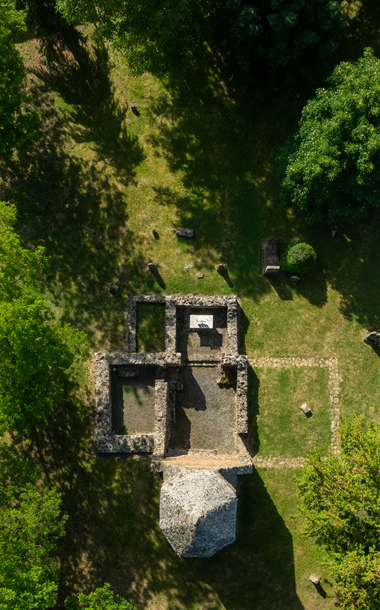
The Avasi Church is perhaps the oldest surviving building in Szigliget. During the Roman period, a structure already stood on this site, as evidenced by the herringbone-pattern stonework visible in the walls of the nave of the church ruins uncovered during excavations in 1958. This type of masonry was commonly used by the Romans and is otherwise unknown in Hungarian medieval ruins. Numerous rimmed, red-painted Roman brick fragments discovered during the excavations further confirm the existence of the earlier Roman structure. It is believed that a small population continued to live in this Roman-inhabited area through the period of the Hungarian Conquest and later assimilated into the Hungarian population, establishing the foundations of medieval Szigliget on the same site. According to a boundary survey document from 1420, a stone church dedicated to All Saints still stood in the village of Szigliget at that time. Since there is no other suitable settlement area within Szigliget besides the surroundings of the Avasi Tower, and no Árpád-era finds have been discovered elsewhere, historians believe that the All Saints Church mentioned in the document must have been the present-day Avasi Church, which once served as the parish church of medieval Szigliget. Between 1260 and 1262, local craftsmen associated with the Atyusz family’s building workshop transformed the former Roman structure into a Christian church. Architecturally, it resembles the towers of the churches at Egregy and Felsőörs, although in its proportions and decorative details it is much simpler and artistically more modest. A straight-ended sanctuary was added to the Roman building, along with a smaller sacristy or charnel house, while a massive tower — square at the base, hexagonal in the middle, and octagonal at the top — was attached to the northwestern end of the nave. It remains uncertain whether these additions were constructed simultaneously. Roman brick fragments reused within the sanctuary foundations indicate later construction phases. The lower section of the wall between the tower and the nave originally formed part of the nave wall itself. Since no traces of an entrance were found in this wall, it was reconstructed as a solid wall during restoration work for structural reasons. The nave was once covered by a gabled roof. A larger adjoining room on the northeastern side of the nave may have functioned as a chapel. Fragments of plaster decorated with reddish-brown and green painted lines discovered inside the nave prove that the church interior was once painted. In the second half of the 19th century, Iván Ádám reportedly observed a mural depicting the face of Christ and decorative scrolls above one of the tower entrances, though only faint traces remain visible today. Records from 1333 and 1334 mention a parish priest named István, who paid 22–23 broad denars as papal tithe — a notably small amount compared to neighbouring villages. The original settlement surrounding the church had likely already begun to decline during this period, and according to the 1420 document, it had become completely deserted by the early 15th century. The destruction of the church accelerated during the Turkish attacks of 1558 and continued throughout the Ottoman occupation. After the liberation of Hungary from Ottoman rule, the abandoned church was never restored and gradually fell further into ruin. Its stones were carried away and reused in the construction of village houses. The repopulation of Szigliget began more intensively during the 18th century at the foot of the castle hill, where the present-day village developed. As with many ancient ruins, numerous legends became associated with the Avasi Tower. One of the best-known is the legend of the Stone Goat: “Long ago, there stood a stone goat in front of the church. Children used to climb and play on it. One Sunday, a soldier arrived and split the stone goat in half with a large axe. It was filled with gold coins. The goat had supposedly been left there by the Turks, and since the soldier himself was Turkish, he knew what treasure it concealed. He took all the gold away, and later the children broke apart what remained of the stone goat.” Many other local beliefs are also connected to the tower. Some refer to it as a “Turkish relic,” while others believe it to have been the ruins of a monastery church belonging to the “Red Friars.” According to local stories, the area around the tower was once wild and overgrown. During road construction and while digging the foundations of nearby houses, numerous bones and skulls were discovered around the site. Many people were initially afraid to live nearby, especially because the dead were once temporarily placed inside the tower before burial. Today, however, the surroundings have become built-up, and at least part of the tower’s long and mysterious history has gradually come to light.