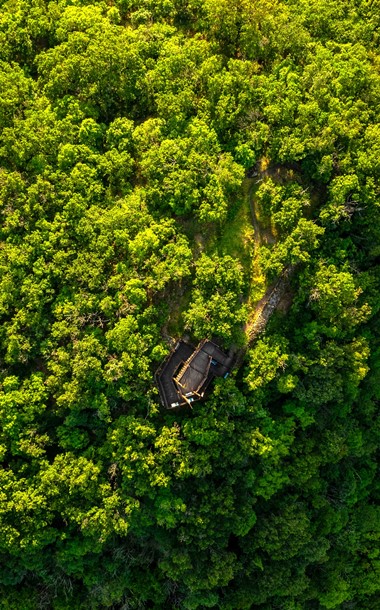
ÓVÁR (Old Castle)
Few people know that beneath the bushes and soil of the hill known as “The Queen’s Skirt” (Királyné szoknyája), the foundation walls of an ancient fortification are hidden. The hill rising above the beach reaches a height of 182 metres. Following minor archaeological excavations carried out in April 1956, the ground plan of a ruined fortress became known. A rectangular structure measuring approximately 12 x 25 metres was discovered, with the foundation walls of a 6 x 7 metre tower attached to its southern side. The walls, measuring between 1.7 and 2 metres thick, were constructed with both inner and outer faces made of large carved stones. The age of the structure could not be determined based on the few indistinct pottery fragments uncovered during the short excavation. However, the carved stones suggest that the remains may belong to a Roman watchtower. The Romans ruled the province of Pannonia for approximately four centuries, and one of their most important military roads — connecting Savaria and Sopianae — passed through this region. It is believed that this small fortress may have been built from massive stone blocks to protect that route. The conquering Hungarians are thought to have found the ruined walls already standing here, and later, after the construction of the new castle at Szigliget, the site became known as “Óvár” (“Old Castle”). Another name for the hill, “Öreghegy” (“Old Hill”), refers to the fact that the village’s oldest vineyards were once located here. Viticulture in this region was most likely introduced by the Romans, just as the local passion for fishing may also originate from that era. The traditional fishing spear used for carp fishing — requiring remarkable skill to handle — closely resembles the three-pronged trident depicted in Roman statues of Neptune. According to other theories, the Óvár was built by the Atyusz clan during the 12th–13th centuries. There is also a local legend claiming that the fortress was never actually completed: whatever was built during the day mysteriously collapsed each night. The owner of the castle, who lived in Somogy County, eventually abandoned the project after repeated failures. This folk tradition may well preserve some element of historical truth, later enriched by local storytelling. The near-total absence of archaeological finds and the relatively even level of the ruined walls leave this possibility open. According to another theory, the site may have been intended as the “small castle” near Lake Balaton mentioned in a letter written in 1647, in which Gáspár Lengyel — lord and captain of the Szigliget castle — planned to build a private fortress at his own expense. According to this version, the castle was never completed. On the other hand, if we assume that someone did indeed manage to build a small fortress upon the Roman remains, another plausible theory suggests that in 1616 the soldiers of Sándor Bakáts — captain of the naval flotilla stationed here — occupied the still usable small fortress of Óvár. Unfortunately, even the most recent archaeological excavations conducted in 2003 failed to conclusively determine either the builder or the exact age of the structure. Until clear written evidence or definitive archaeological discoveries emerge, no certain conclusions can be drawn about the history of Óvár. Thus, the ancient structure continues to guard its secrets.