What Do the Coats of Arms of Szigliget and the Surrounding Settlements Tell Us?
JÓZSEF SZÁSZI
Székesfehérvár, Tóparti Secondary School and Arts Vocational School; Ez az e-mail-cím a szpemrobotok elleni védelem alatt áll. Megtekintéséhez engedélyeznie kell a JavaScript használatát.
The chapter presenting the origins of geographical names in Szigliget and the surrounding area, as well as the coats of arms of the settlements, was omitted — for reasons of content and length — from my study titled What the Inselbergs of Szigliget and Its Surroundings Tell Us (Szászi J. 2022a), published in issue 2/2022 of the journal GeoMetodika. These sections were and are being published in the Outlook column on the GeoMetodika website. My previous article (Szászi J. 2022b), published in June, dealt with the origins of geographical names in Szigliget and its surroundings, and I hope it drew colleagues' attention to the importance and usefulness of knowing the origins of geographical names. With the present article on the coats of arms of the settlements around Szigliget, I would like to illustrate how we can enrich our teaching of the complex physical and human geography of the Tapolca Basin, both in and outside the classroom.
What Is a Coat of Arms?
Before describing the characteristics of the coats of arms of the settlements in the area, I would briefly like to clarify what a coat of arms is. "A badge (and symbol) placed on a heraldic shield, consisting of geometric forms or stylised images. Only a work of art that complies with the rules defined by heraldry can be considered a coat of arms. Historical-noble heraldry encompasses coats of arms granted by rulers and inherited in a defined manner. In historical-communal (municipal) heraldry, only the ruler could grant a coat of arms (seal) even to free royal towns. Hungarian law does not recognise noble titles and ranks; however, the coats of arms of historical Hungarian noble families remain the property of those families — or their heirs — to this day. Their use for other purposes (e.g. as a municipal coat of arms) may only take place with the consent of the owners. … Today's coats of arms, as colourful symbols — which may also appear on seals and badges — serve to identify their owners as various legal entities (e.g. municipal councils, schools, associations)" (Szászi J. 2007, p. 5.).
Following the change of regime, a new era began in the local history of Szigliget. Archaeological excavation and architectural reconstruction of Szigliget Castle commenced with the support of the Szigliget "Castle Foundation", in which I myself actively participated as a former member of the foundation's board of trustees. In 1992, I designed the very first municipal coat of arms for my home village, Szigliget. In the following years, I also designed the coats of arms for the other settlements situated at the foot of the inselbergs of the Tapolca Basin. In this article, I present the municipal coats of arms of Szigliget and the surrounding area, grouped partly in chronological order, partly according to historical considerations, but primarily from a geographical perspective.
The Coats of Arms of the Settlements of the Tapolca Basin
The Coat of Arms of Szigliget with the Castle
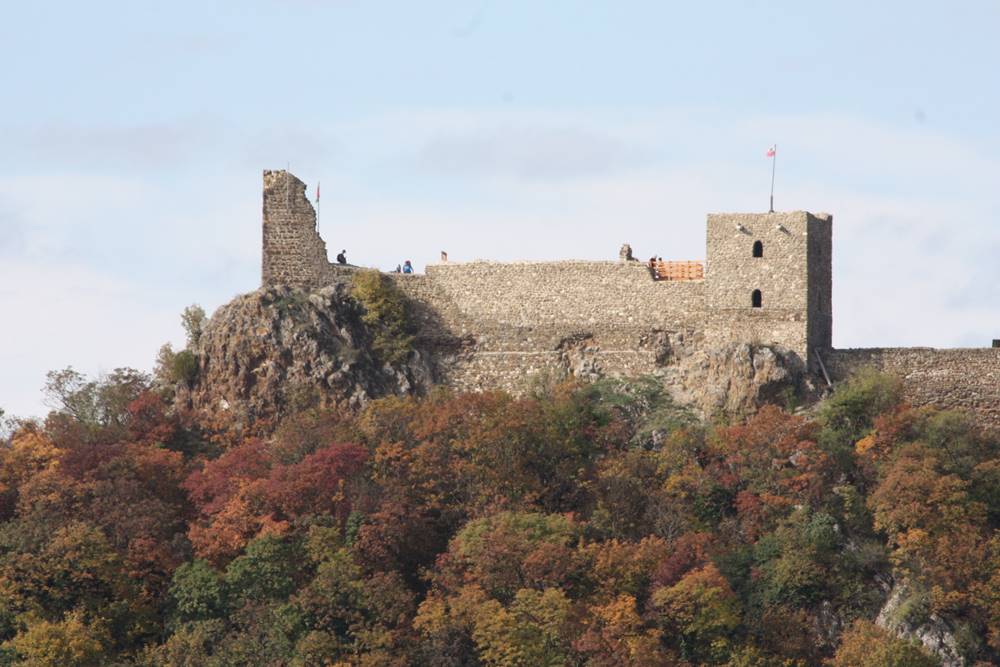
The coat of arms of Szigliget depicts Szigliget Castle. The image on the shield was created with minor modifications based on the impression of the village's wax seal dated 1861 (Kozák K. 1960). The depiction of the castle on the seal is surprisingly true to life, even though the castle was destroyed by a lightning strike and subsequent fire in 1697. By the 19th century the castle was already heavily ruined, as evidenced by several contemporary depictions. The likely explanation is that the image on the seal stamp dated 1861 may have been a faithful copy of an earlier seal stamp. Although that earlier seal has been lost, its existence is mentioned in a document from 1697. When the previous seal stamp was made, the burnt-out castle still stood — hence the lifelike depiction. This is further supported by an engraving surviving from the 17th century, which depicts the castle in a very similar manner to the 1861 seal. Moreover, based on the engraving, it can be established that the image on the seal shows the keep standing at the highest point of the castle and the palace wings extending on either side, as seen from a south-easterly direction.
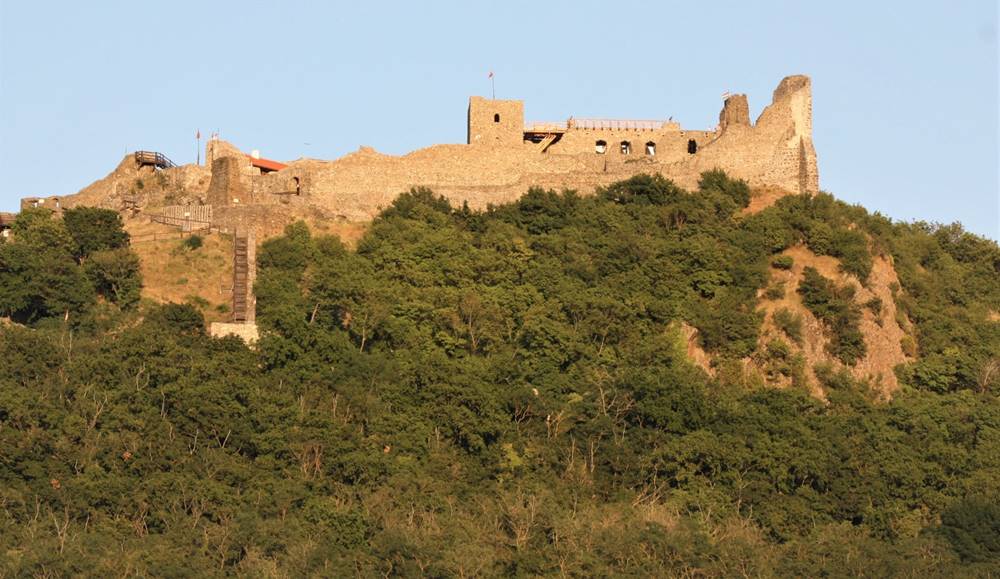
The ruins of the keep and the multi-storey palace wings extending to the west and north of it now rise — partially restored — above the old village. The double hill visible on the coat of arms also accurately depicts Castle Hill (Vár-hegy). The lower, smaller hill beneath the larger one symbolises the lower rocky saddle adjoining the hill from the south (Szászi J. 1992).
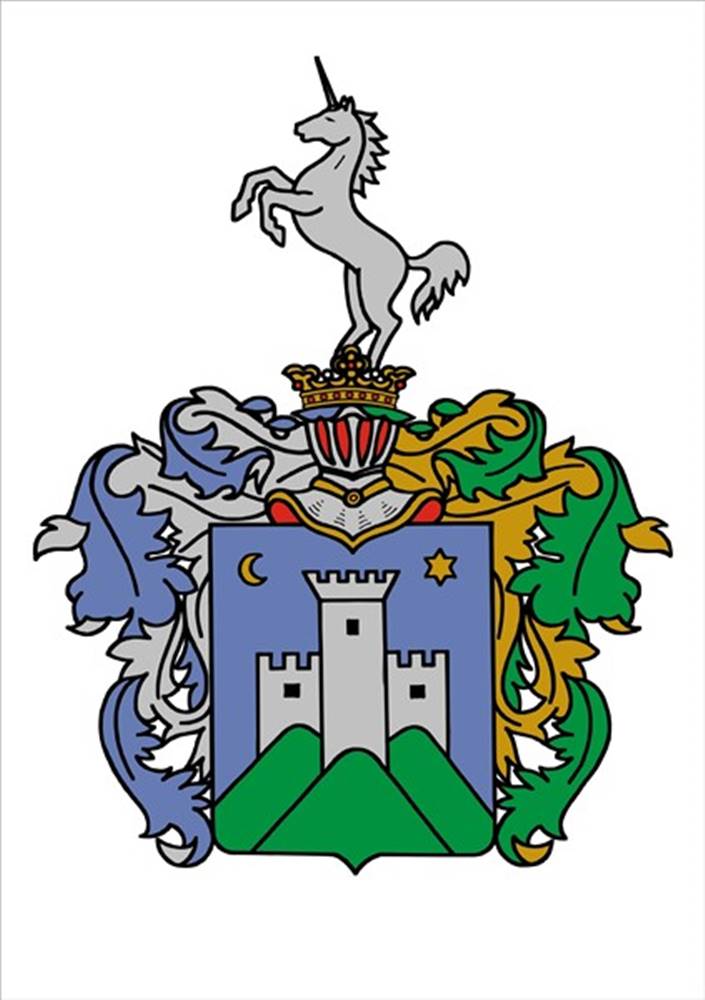
When the coat of arms of Szigliget was being created, some members of the local council at the time expressed the intention to adopt the coat of arms of the Tóti Lengyel family as the village's coat of arms. This carved sandstone coat of arms, which has survived to this day, was originally set into the wall above the castle gate; since the castle's destruction, it has been displayed on the baroque stone gate of the Tóti Lengyel manor house.
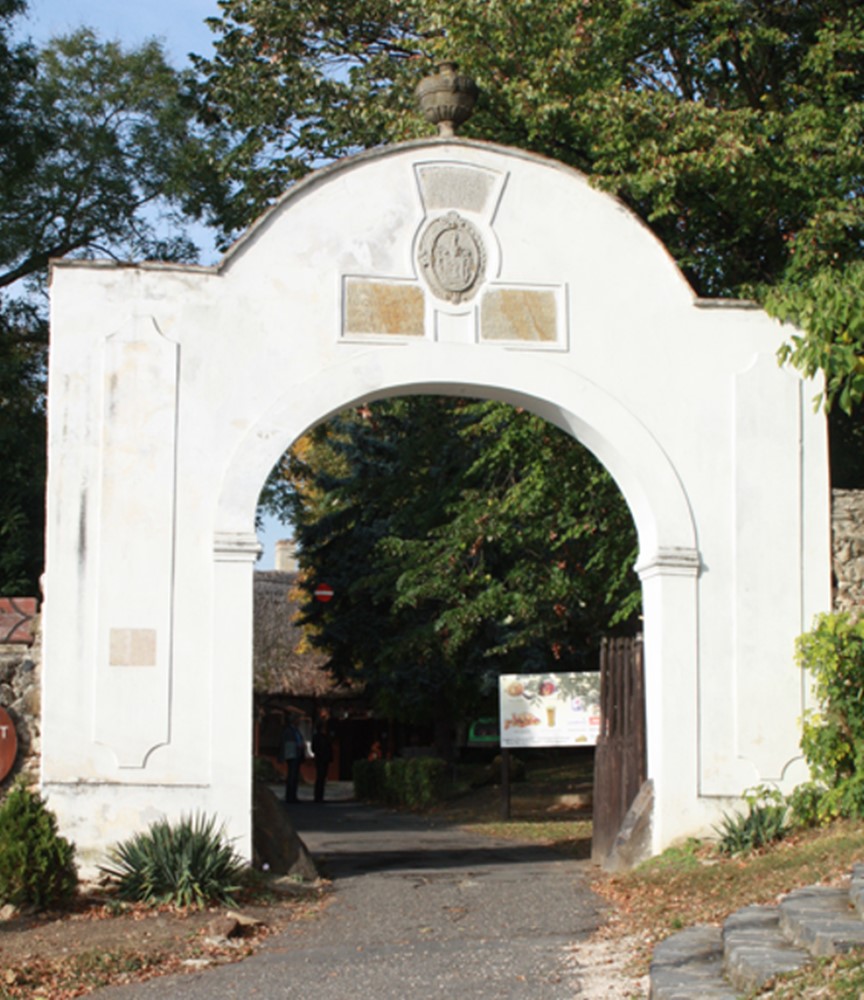
On my recommendation, the shield derived from the village's 1861 seal was adopted — with two minor additions (a crescent moon and a star). Furthermore, the shield was supplemented, in accordance with the rules of heraldry, with a baroque-style helmet, mantling, and as a crest, a rearing unicorn atop the helmet crown. Since the external ornaments of the coat of arms are derived from the coat of arms of the Tóti Lengyel family, these additions are heraldically and historically authentic. In summary: the coat of arms of Szigliget tells the history of Szigliget and its castle, while the green hills allude to the geographical character of Castle Hill (Szászi J. 1992).
The remaining municipal coats of arms are presented — arranged geographically — moving from south to north, since the coats of arms of the small settlements at the foot of the inselbergs (Badacsony, Gulács, Tóti Hill and Csobánc) running along the eastern edge of the Tapolca Basin directly or indirectly feature the inselberg adjacent to the settlement.
The Badacsony in the Coat of Arms
The coats of arms of Badacsonytördemic (formerly Nemestördemic) and Nemesgulács differ from the other coats of arms presented here for historical and heraldic reasons. As their names suggest, these were once noble villages and had previously possessed collective noble coats of arms. For this reason, I supplemented the shields of both villages with the accessories of noble heraldry (helmet, crest and mantling), while modifying the depiction on the shield in both cases.
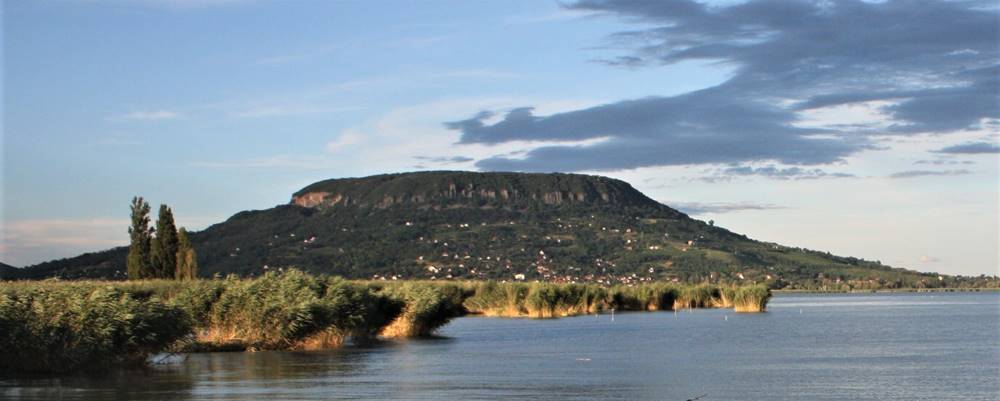
The first part of the name Badacsonytördemic derives from the truncated cone-shaped hill that rises above the settlement. The origin of the name of the Badacsony, a 437-metre-high inselberg, is uncertain — it may derive from the personal name Bodach of unknown nationality — while the Tördemic suffix of the name may derive from a Hungarian personal name (Kis L. 1983).
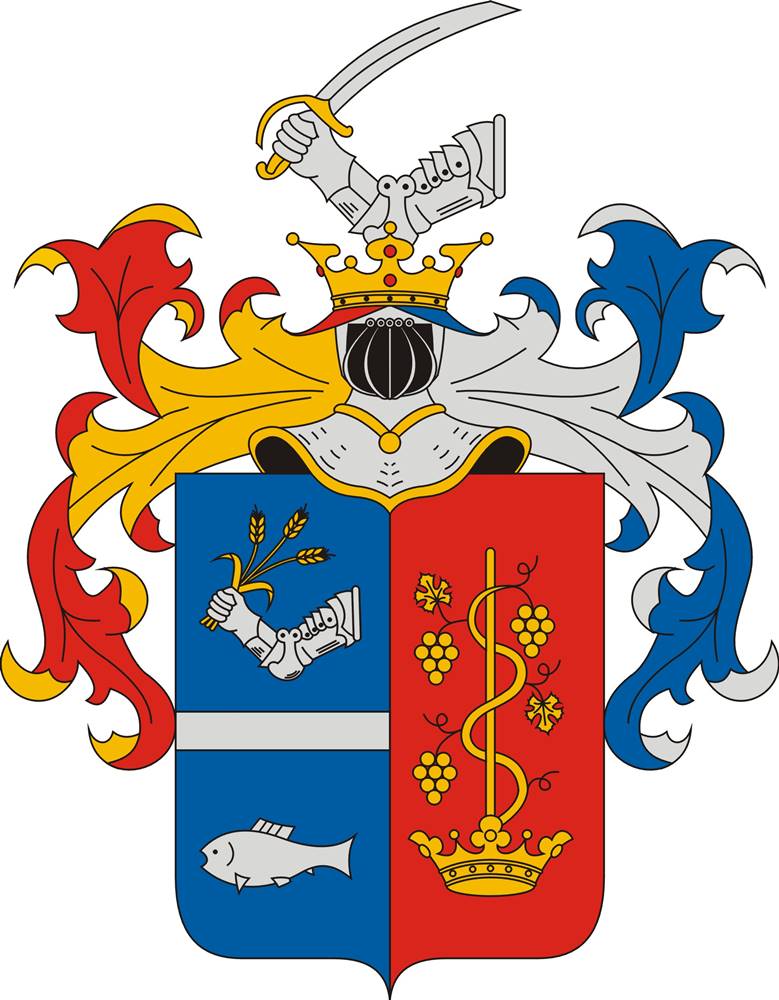
The history of the village is symbolised in the coat of arms by the vertically divided shield with blue and red fields. The blue field represents Nemestördemic. The blue shield divided by a silver fess (stripe) derives from the coat of arms of Zala County, to which the village belonged for many centuries. The silver fish motif below the stripe symbolises Lake Balaton and the long-standing tradition of fishing. Above the stripe, the silver armoured arm holding three golden wheat ears is a motif taken from the old seal of Nemestördemic. The red field carries a dual meaning: on the one hand, it represents Lábdi Hill and Badacsonylábdi (Lábdi was an independent settlement in the Middle Ages, taking its name from the Lád clan of the Hungarian conquest [Kozák K. 1960]). On the other hand, the golden vine growing from a golden crown in the red field symbolises the famous wines of the Badacsony region (Szászi J. 1994).
The Inselbergs of Gulács, Tóti Hill and Csobánc in the Coats of Arms
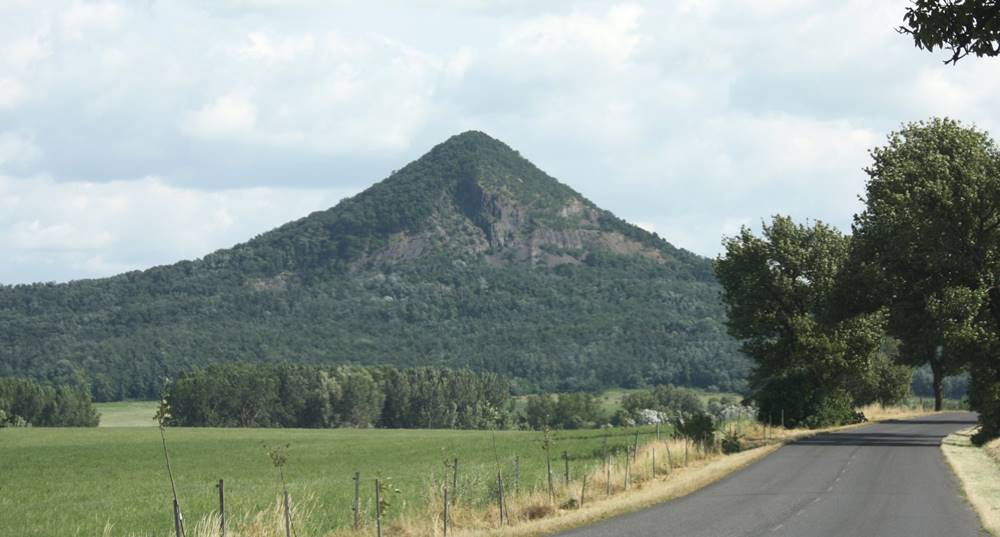
The suffix Gulács in the name of Nemesgulács derives from the name of the inselberg that rises above the village. Gulács is a 393-metre-high volcanic inselberg whose name may derive from the Slavic word golacs, meaning a bare, bald hill; alternatively, the hill's name may have originated from the personal name Gula with the diminutive suffix "cs" (Kis L. 1983). The people of Nemesgulács affectionately nickname this imposing, perfectly cone-shaped inselberg the "Hungarian Mount Fuji".
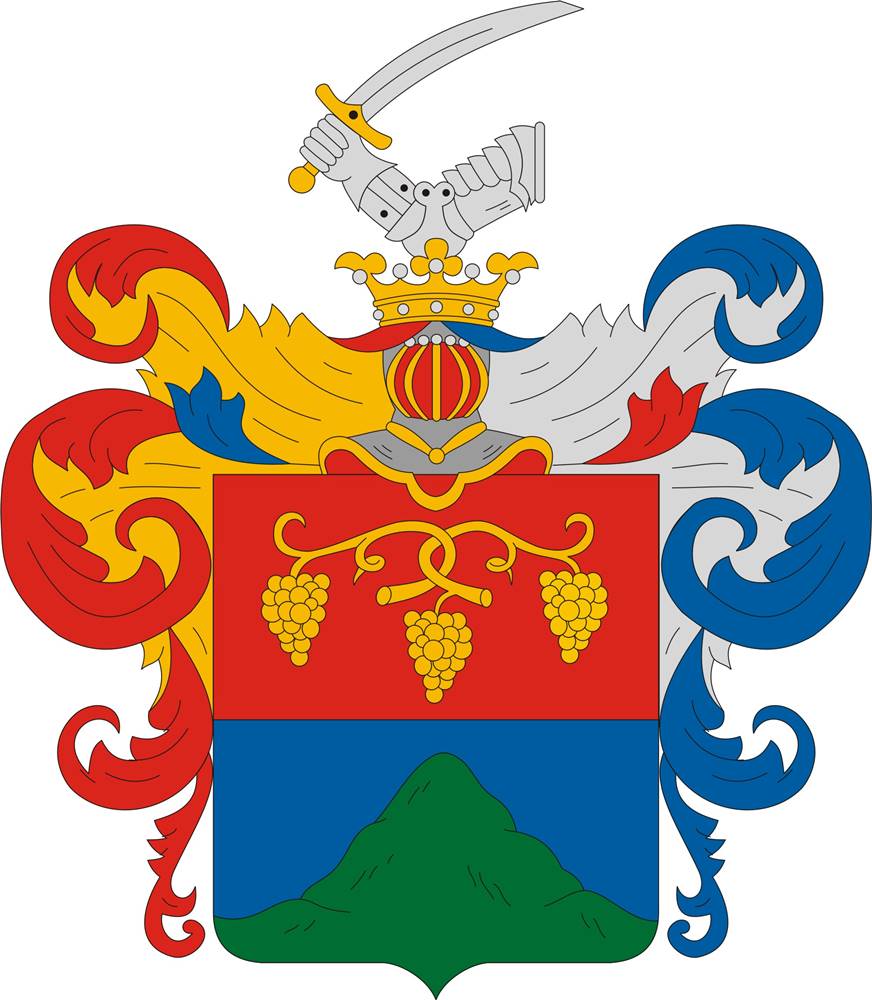
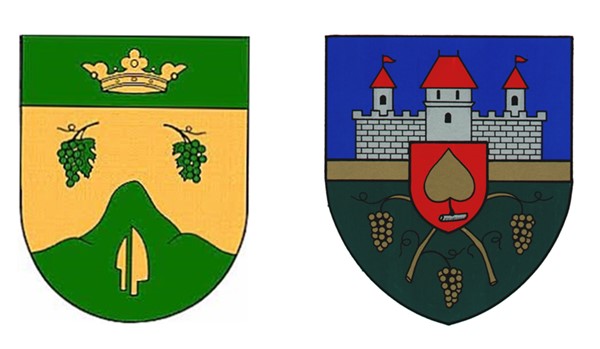
The settlement has a very fine surviving wax seal impression, so when designing the new coat of arms of Nemesgulács, I based it on the original armorial seal image, though I modified the depiction on the shield here as well. Instead of the arm holding a sword visible in the undivided shield of the armorial seal, the horizontally divided shield shows Gulács in green on a blue field in the lower half, while the upper red field features two golden vine branches symbolising the fine wines produced here. The external ornaments were transferred unchanged into the new coat of arms of the settlement (Szászi J. 2000a).
The Káptalan prefix in the name of Káptalantóti derives from the fact that the chapter of Győr Cathedral once held estates in the village (Kis L. 1983). The cone-shaped hill visible in the coat of arms depicts the 347-metre-high Tóti Hill. Unlike Gulács, however, this inselberg took its name from the charming little village nestled at its foot. The origin of the name Tóti most likely does not derive from the modern Slovak ethnic name, but was formed from the name of a smaller South Slavic (Slovenian-Croatian) ethnic group called tót (Kis L. 1983). The stylised golden ploughshare and coulter visible beneath the green hill in the golden field of the shield symbolise the village itself, as this motif is taken from the village's seal dated 1796. The two bunches of grapes here also symbolise the fine wines of the village. The open golden crown in the green chief of the shield was taken from the coat of arms of Zala County, to which the village belonged for many centuries (Szászi J. 1995).
Gyulakeszi is likewise an ancient settlement at the foot of the 376-metre-high volcanic inselberg called Csobánc. The name of the inselberg may possibly derive from the Old Turkish word csobán (shepherd), though a Slavic origin is also possible — in which case the hill's name may derive from the Slavic word csobán (csobolyó — a flat, barrel-like, two-bottomed wooden vessel made of staves, sealed with a stopper, used for carrying and drinking). The Gyula prefix in the settlement's name derives from the name of the Gyulaffy family. A 15th-century document still refers to the village as Gyulafikeszi. The historical explanation is that both Csobánc Castle and the village of Keszi were the property of the Gyulaffy family of Rátót for three hundred years. The name Keszi derives from the name of a Hungarian tribe from the time of the conquest (Kis L. 1983).
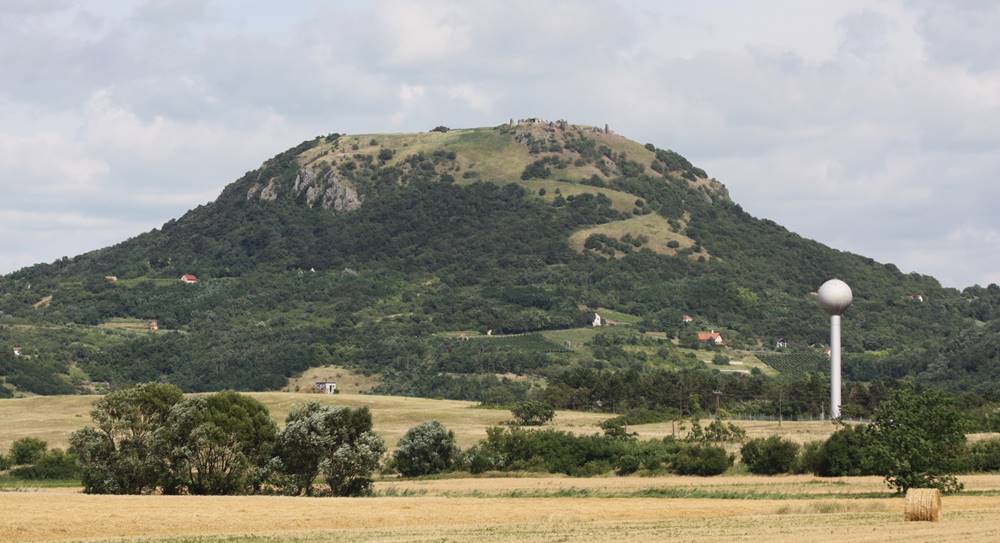
The shield of Gyulakeszi is horizontally divided by a golden fess, with a blue field above and a green field below. The upper field shows a stylised depiction of Csobánc Castle — as seen from the north, the former castle would have appeared similarly on the plateau of the truncated cone-shaped inselberg. In the coat of arms, the large central tower projecting from the middle of the castle wall represents the former residential tower of Csobánc Castle, whose ruin — partially restored in recent times — still stands on the hilltop today. The two golden vine branches in the lower field allude to the fine wines produced on the hill. The smaller shield (inescutcheon) in the centre of the shield was taken unchanged from the coat of arms of the Gyulaffy family and incorporated into the village's new coat of arms (Szászi J. 2000b).
The Coats of Arms of the Settlements around Szent György Hill
Three small settlements are situated around the 415-metre-high Szent György Hill (St George's Hill) standing in the middle of the Tapolca Basin, arranged from east to west: Kisapáti, Hegymagas and Raposka. Accordingly, when designing the coats of arms of all three settlements, the stylised depiction of Sint György Hill — as a tent-shaped inselberg — was incorporated into all three coats of arms.
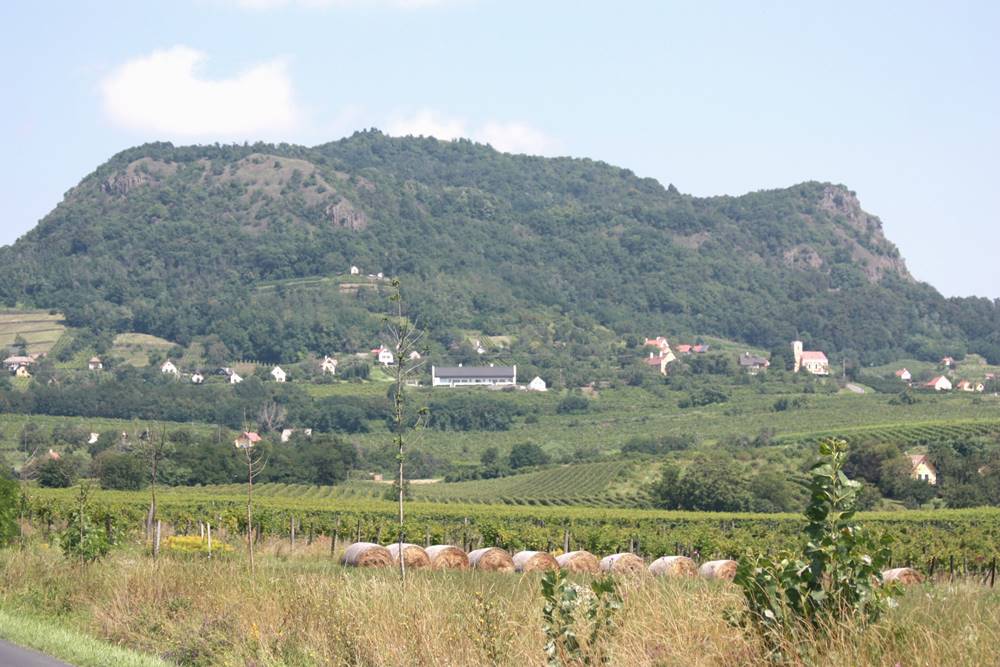
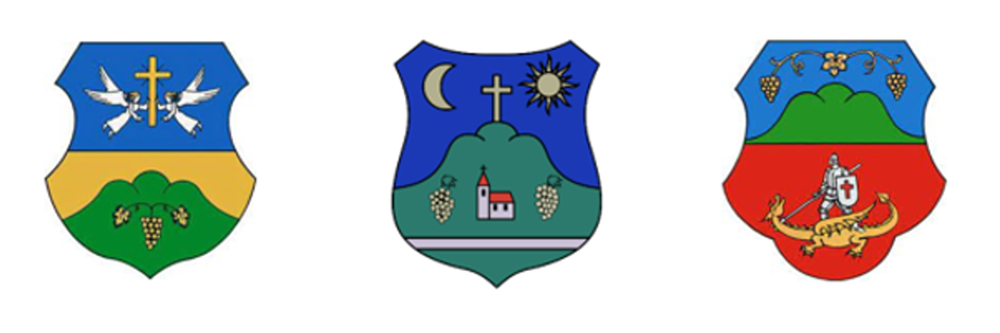
Kisapáti is a settlement lying at the south-eastern foot of Szent György Hill. Its coat of arms is a horizontally divided roundel shield. The green hill ending in a triple mount in the lower golden field is a stylised depiction of Szent György Hill. The former name of this inselberg was Hegymagos (high hill). The first written mention of the name Kisapáti appears together with this hill in a document from 1222: "in villa Apaty in Higmagos". The hill acquired its current name from the Chapel of St George, built during the Árpád era but since destroyed (Kis L. 1983). The golden bunch of grapes beneath the green hill in the coat of arms symbolises the famous wines produced on Szent György Hill. In the upper blue field, the golden cross alludes to the village's name, as Kisapáti was named after the Benedictine Abbey of Pannonhalma, which held estates here. The prefix Kis (Small) serves to distinguish it from the nearby Monostorapáti (Szászi J. 1993).
Hegymagas is a settlement lying at the western foot of Szent György Hill, at the far end of which the Tapolca Stream flows at the hill's base. The coat of arms of the settlement is an undivided roundel shield. In the blue field — similar to that of Kisapáti — a green hill ending in a triple mount symbolises Szent György Hill. The reason I depicted this inselberg in this form is that, unlike the neighbouring volcanic inselbergs (Badacsony, Csobánc), it is not a truncated cone but tent-shaped (i.e. a smaller peak rises from the hill's plateau). The first written mention of the name Hegymagas survives in the form Ugmagos in a charter dated 1093. Originally, the name Hegymagas (high hill) referred to Szent György Hill, but a name exchange later took place: the hill was named after the Chapel of St George, built during the Árpád era but since destroyed, while the village adopted the hill's former name (Kis L. 1983). According to one hypothesis, the chapel that gave it its name may have stood on the site of the Lengyel Chapel, built in baroque style on the southern slope of the inselberg in the 18th century; others believe it may have been built on the summit of Szent György Hill. The golden crucifix on the hilltop in the coat of arms is an allegorical motif referring partly to St George the knight and partly serving as a memorial to the turbulent and suffering-filled history of the village. Furthermore, the golden Sun and crescent moon floating above the hill are not merely decorative motifs — in heraldry they carry multiple meanings, and can for example symbolise the male and female principles. The silver church beneath the hill represents the village, while the two bunches of grapes refer to the famous wines of Szent György Hill. The horizontal silver bar (fess) symbolises the Tapolca Stream flowing at the foot of the hill (Szászi J. 1995).
Raposka is a settlement at the north-western foot of Szent György Hill, alongside which the Tapolca Stream flows. Its first written mention appears in the form Repesoka. The name of the settlement was formed from the combination of the family name Repe and the word sok (village) (Kis L. 1983). The coat of arms of the village is a horizontally divided roundel shield. The green hill ending in a triple mount in the blue field symbolises the tent-shaped Szent György Hill rising in the middle of the Tapolca Basin, and the golden vine floating above the hill is a motif alluding to the renowned wines produced here. In the lower red field, St George the knight slaying the dragon is a motif referring to the name of the inselberg. According to church history, St George the knight did not actually exist; his mythological figure symbolises the Christian belief that faith always triumphs over evil (Szászi J. 2000c).
Summary
In summary, all the coats of arms presented here are so-called canting arms, since — directly or indirectly — they tell the name, geographical location and history of the settlements. The two cone-shaped inselbergs (Gulács and Tóti Hill) in the coats of arms of Nemesgulács and Káptalantóti refer to the name and geographical location of the settlement. In the case of Gyulakeszi, the coat of arms of the Gyulaffy family on the inescutcheon also tells the settlement's name. The characteristic shape of the inselberg Szent György Hill, appearing in the coats of arms of all three, symbolises the geographical location of Kisapáti, Hegymagas and Raposka. The castle visible in the coats of arms of Szigliget and Gyulakeszi alludes to the turbulent history of the two settlements and serves as a memorial to the bravery of the soldiers who defended the two border fortresses against the Ottomans. The coat of arms of Badacsonytördemic contains motifs referring both to the geographical location and to the history of the settlement. Finally, all the settlements presented here lie within the famous Badacsony wine region, and therefore — with the exception of Szigliget — the coat of arms of each features a vine, which is a heraldic motif indirectly referring to the physical and human geographical character of the settlements.
References
- Kis, Lajos (1983): Földrajzi nevek etimológiai szótára [Etymological Dictionary of Geographical Names]. – Akadémia Kiadó, Budapest. 727 p.
- Kozák, Károly (1960): A szigligeti vár [Szigliget Castle]. – Veszprém County Council Tourism Office, Veszprém. 111 p.
- Szászi, József (1992): Szigliget címere és zászlaja [The coat of arms and flag of Szigliget]. – Manuscript, Székesfehérvár. 5 p.
- Szászi, József (1993): Hegymagas címere és zászlaja [The coat of arms and flag of Hegymagas]. – Manuscript, Székesfehérvár. 3 p.
- Szászi, József (1994): Badacsonytördemic címere és zászlaja [The coat of arms and flag of Badacsonytördemic]. – Manuscript, Székesfehérvár. 3 p.
- Szászi, József (1995a): Káptalantóti címere és zászlaja [The coat of arms and flag of Káptalantóti]. – Manuscript, Székesfehérvár. 3 p.
- Szászi, József (1995b): Kisapáti címere és zászlaja [The coat of arms and flag of Kisapáti]. – Manuscript, Székesfehérvár. 3 p.
- Szászi, József (2000a): Nemesgulács címere és zászlaja [The coat of arms and flag of Nemesgulács]. – Manuscript, Székesfehérvár. 3 p.
- Szászi, József (2000b): Gyulakeszi címere és zászlaja [The coat of arms and flag of Gyulakeszi]. – Manuscript, Székesfehérvár. 3 p.
- Szászi, József (2000c): Raposka címere és zászlaja [The coat of arms and flag of Raposka]. – Manuscript, Székesfehérvár. 3 p.
- Szászi, József (2020a): Amiről Szigliget és a környékbeli tanúhegyek mesélnek [What the Inselbergs of Szigliget and Its Surroundings Tell Us]. – GeoMetodika 6. 2. pp. 85–100. (link)
- Szászi, József (2020b): Miről mesélnek Szigliget és környékének földrajzi nevei? [What Do the Geographical Names of Szigliget and Its Surroundings Tell Us?] – GeoMetodika (link)
- Szászi, József (2007): Fejér megye címerei [The Coats of Arms of Fejér County]. – Lánczos Kornél – Szekfű Gyula Scholarship Foundation entry, manuscript, Székesfehérvár. 214 p.
Featured image: Szigliget Castle on the coat of arms shield of the settlement (photo: J. Szászi)
I dedicate this article to the memory of my former secondary school headmaster and geography teacher, Tibor Navracsics Sr.