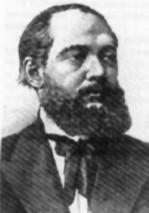
KÁROLY EÖTVÖS
TRAVELS AROUND LAKE BALATON
THE MOST BEAUTIFUL LANDSCAPE IN THE WORLD
(EXCERPT)
“It was already late afternoon when the shepherd of Szentmihály Hill finished his tales.
We commended him to God’s protection and set off toward Szigliget.
When we reached the direction of Meszes-Györök, where the road turns northward, the sun was already preparing to set. It still poured its rays with full strength upon the landscape spread before us, yet the rays had already begun to turn golden and red. And in the glow of those reddening beams a panorama opened before me unlike anything genius itself had ever created. Nor even dreamed of.
The Bay of Szigliget smiles before me. The largest bay of Lake Balaton. Badacsony leans out over the lake like a peninsula. Toward the east, where I stood upon the Meszes-Györök headland, Badacsony closes off the distant horizon at one point. To the left, the Bay of Szigliget stretches deep inland for half a mile.
A valley opens onto the bay: the valley of the Lesence and Tapolca streams. One pours its mill-turning, song-creating waters into the Balaton in the middle of the bay, the other beside Szigliget. Behind me rises a dark mountain range, straight northward toward Sümeg and the Uzsa Valley. This is the Black Mountain and Dragon Forest. Its slopes are filled with villages, and among them inns, farms, homesteads, and mills gleam white. This mountain chain forms the western side of the Lesence Valley and the Bay of Szigliget. Far to the north the mountain of Haláp closes the view. Eternal underground fires created this mountain as well. It too is cone-shaped like its brothers, as though standing alone upon the plain. Yet its summit is cut flat, as if the hand of God had trimmed it level with scissors. It has no brothers in this region. Its only twin lies far away in Kemenesalja: Mount Ság, though it cannot be seen from here.
The western side of the Lesence Valley and the Bay of Szigliget is indescribable. Even a hundred songs by a hundred poets could not recount its beauty — unless painter and sculptor came to their aid. And even that would not be enough. A soul is needed here: one capable of feeling and of adoration, Hungarian in every fibre of its being. (…)
Before me rise the wooded peaks of Szigliget. Small peaks indeed. But above one of them stands the ruin of the ancient castle: broken walls, collapsing towers, masses of roofless corridors. The castle ruin stands there like the decayed crown upon the head of an old king. Through the openings of doors and windows breaks the sunlight, and from afar that light appears like jewels upon the crown.
Ah, crumbling Castle of Szigliget, how many duties you neglected! The Turks did not harm you, nor did you trouble the Germans. In the great struggles of our nation you played no role. Yet your lord possessed two hundred and eight towns and villages in Zala and Somogy, and still you lived peacefully with everyone. The great men of the nation must stand present in all the nation’s battles. They must not avoid combat, prison, or the executioner’s sword. Yet neither should they avoid the sacrifices of peaceful times.
What did you gain through your peace, your cowardice, your wisdom, Castle of Szigliget? Two hundred and twenty-six years ago the wrath of the gods descended upon you, and their lightning scattered your proud towers. Your lord too vanished without trace. His male line died out, his daughters scattered and impoverished, and you yourself became a ruin in foreign hands. Of the once mighty Lengyeltóthy family neither rumour nor ashes remain. It scarcely existed even while it lived — how could it exist now, long turned to dust?
Behind Szigliget the evening sunlight still trembles upon the peaks of Gulács and Tóti. Barren, desolate, too poor even for pasture, with neither vineyard, forest, nor dwelling upon their slopes. Yet their form is marvellous: exactly like the pyramids of Egypt. Like chicks beside a brooding hen, these youthful rocky cones stand beside old Badacsony. (…)
By the time we reached the Kutyafarka Inn, I was as hungry and weary as a wolf. This inn stands at the northwestern corner of the bay near Ederics. Here the road divides into three directions. One is the road by which we came. Another leads north directly toward Tapolca.
The third turns eastward toward Szigliget. This last road is straight as an arrow, and at its end the ruins of the castle rise toward the sky as though a dead giant were lifting its bony arms aloft.
The inn has another name besides Kutyafarka. That other name appears in geography and official documents. But I know it only by this one.
I stopped before the inn and gazed toward Szigliget. I would gladly have flown there, but my legs seemed made of lead. I was exhausted. It would have taken a good hour to walk there. The sun had already set. The dark shadows of Dragon Forest had spread across the inn, the valley, the whispering reeds, and the smooth waters of the bay. It would have been deep night by the time we reached Szigliget. In a small village during the height of summer labour no one remains awake late into the evening. We would scarcely have found lodging or food. We had to spend the night there at the inn. (…)
The region around Lake Balaton possesses many dazzling landscapes. I myself have not explored them all. Even I have not beheld every dreamlike, fairy-tale, and wondrous beauty. A youthful heart, an enthusiastic soul, and a whole lifetime would be needed for that. But all these have already departed from me.
Yet I have stood upon the summit of Badacsony, upon the peak of Tihany’s Csúcs Hill, and upon the highest dune of Balatonszemes’ sandy shore, from where one may overlook the entire Balaton across Veszprém, Somogy, and Zala, from the shores of Kenese to Fenék. From these three points everything may be seen. Yet the landscape grows gigantic there, and its beauties become hazy and immeasurable. It burdens and exhausts the soul. Even beauty gives perfect delight only in moderation. Not even a great painter would know what to do with these three viewpoints. (…)
The Lesence Valley, for example, possesses marvellous scenic beauty, especially from two viewpoints. One lies where the road leading eastward from Keszthely turns sharply north near Balatongyörök. Every human being of sound eye and soul must stop here. I first saw this sight in 1854. My mind reeled at the very first moment, so completely was I overwhelmed by the artistic grace and grandeur of the landscape.
Behind me stretches Dragon Forest from the hermit chapel of Szentmihály Hill up toward Sümeg, though from this viewpoint it cannot be seen. Before me lies the deep Bay of Szigliget with its once-famous castle dreaming in ruins; directly opposite rises majestic Mount Badacsony closing the horizon; farther northward upon the horizon stand the peaks of Gulács and Káptalantóti and the mighty ridge of Castle Csobánc, shining toward us with the glorious radiance of its heroic traditions.
In the background, at the northern end of the Lesence Valley, the panorama closes again. We can barely glimpse the forests of Dobos, for our eyes, souls, and every feeling become fixed upon Mount Saint George, stretching upon the horizon like a gigantic male lion, while behind it the ancient volcano of Haláp rests smoothly and gracefully like a lioness silently watching her shaggy mate and never straying far from him.
Within these boundaries, in the centre, lies the valley with its rivers, veins, brooks, canals, and shining rows of poplar trees — ploughlands, meadows, vast grassy plains, mills, farmsteads, and herds of cattle and flocks of sheep swarming across the pastures. Vineyards adorned with towers, villages, and dwellings line the slopes and feet of the hills along every edge of the radiant panorama. (…)
There is another viewpoint from which the Lesence Valley appears likewise as an artistic dream, a true fairy vision. It lies where, travelling from Köveskál toward Tapolca, we reach the pass of Bács Hill behind Castle Csobánc. Here the Bay of Szigliget, Castle Szigliget, old Badacsony, and the peaks of Gulács and Tóti lie to the left, while Csobánc and Haláp stand to the right; but Mount Saint George rises directly before us, gazing proudly and calmly upon us with its flourishing vineyards and its bare forehead.
Beside Badacsony and Somlyó, it is the third volcanic creation of equal rank — built not by pharaohs or tyrannical lords for vain display, but by the playful spirits of the primeval world.”
THE MOSQUITO PLAGUE OF SZIGLIGET
“Let the gracious reader not be alarmed. There will be no sighing of sacred sorrows, no roaring of patriotic passions, no poetic melancholy, nor intoxicating oratorical fervour in this little reading. I do not write poetry, even if I could. Yet the first two words of that sublime national song fit rather well here. I shall mention that song too, a little.
Know thy homeland!
That might well be the title of this little rambling tale. There is much wisdom in that saying. For one must love one’s homeland — more than anything and forever. But he who does not truly know his homeland cannot truly love it either. Even the ancients knew this: “Ignoti nulla cupido.” Which roughly means in Hungarian: How could I love that maiden unto death whom I do not know? But let us not philosophize too much. Let us begin straight from the middle of things. For I intend nothing more than to remember, to tell stories, to recall the past.” (…)
“It is the year 1844, and we are law students in Pozsony, for the Diet is in session there, along with the Royal Court of Justice. (…) It was mid-July. The Diet had adjourned for a month or six weeks. When the lottery business was over, the law students began discussing where and how they should spend the recess. (…) The students from Upper Tisza counties chose Transdanubia. None of them had ever seen it before. The wondrous Balaton with its miraculous legends. (…) Let us go there! Let us see these places! There lie together the glory of the past and the greatness, splendour, and radiance of the future!”
“So spoke the law students of the Upper Tisza counties. The victory was theirs. They immediately drank heavily to celebrate their triumph. And they decided to depart without delay — the very next day after lunch. (…)
But now where should they go? To Csobánc or to Szigliget? To both. Indeed even to Badacsony as well. For all this is sacred ground, sung and sanctified by the lyre of the great poet. How could they appear before the great poet himself if they had not first visited every famous place of his Helicon?
As they reached the pass of Bács Hill, the Eger Valley opened before them with the pyramids of Gulács and Tóti, and the solemn majestic forms of Csobánc, Saint George Hill, and Badacsony. Is there anywhere in the world a landscape gentler and yet more beautiful than this? In the farther distance rise Haláp and Szigliget, and opposite to the west the dark forested peaks of Rezi Castle and Tátika. They stood amazed. Speechless, as though turned to stone. The booming voice of Miklós Lakatos was the first sign of awakening.
‘Take off your hats, boys! As if we stood in a cathedral! Indeed it is a holy church, but its master builder was God Himself. And He did not work with coarse engineers, German foremen, or drunken masons.’
They climbed the ruins of Castle Csobánc, the eagle’s nest of the world-famous hero László Gyulaffy, the sorrowful dwelling of the fatal love of Rózsa Gyulaffy. They walked around the crumbling walls and gazed down from the heights. A shepherd boy explained the beauties to them.
‘There lies the Dobos Forest. And beyond that the old Bakony Mountains. We thought we had left them behind at Veszprém and would never see them again. Far to the north, on the boundary of earth and sky, rises the blue mountain of Somlyó, and beside it, in Kemenesalja, the summit of Ság. We shall reach them one day as well.’
From the heights they perfectly beheld the beauties of Saint George Hill. They even found the road where Rózsa’s bridegroom, young Master László, had galloped ahead to his dying bride. Józsi Apostol had brought with him the legends of the great poet.
‘Here the horse of young Master László stumbled when the hare crossed before him upon the road. And there is the rock where the ominous owl hooted!’
And what of the bell?
‘Sadly he heard tolling
A bell within the castle,
What can it mean? The mighty wind
Carried away its sound.’
The bridegroom heard the bell, but the law students heard it no more. There was no tower left in Castle Csobánc, and no soul bell rang there any longer. Only fragments of broken walls stood where the splendid fortress had once risen. The cruel fury of the Germans had destroyed everything — exactly one hundred and thirty years before the students of Pozsony visited the place.
The students could not even carve their names upon the shattered walls. At the foot of the castle they enjoyed a lavish feast at the miller’s house in Gyulakeszi. From there they travelled directly to Szigliget. Barely ten kilometres away, yet dusk had already fallen by the time they reached the village. They had to stay the night there.
But there was no inn, no guest room — what should they do?
Baron Puteáni was lord of Szigliget, one of the heirs of the famous, ancient, and immensely wealthy Lengyel family of Lengyeltóti. A cheerful gentleman with a comfortable manor house — let us visit him! Yet some of the students refused. One day at least should be spent resting. What if they were again forced into another night of revelry? For four days already it had been wedding feast upon wedding feast across hills and valleys. Let there finally be some fasting as well!
Dani Oláh reasoned likewise with Miklós Lakatos. Two others joined them. Three of the group visited the nobleman and remained there as his guests.
Poor peasant folk lived in Szigliget. The remaining four law students lodged at a sturdier-looking peasant house.
‘Good evening, goodman! We are law students travelling the country. Night has overtaken us. We have everything we need except a place to sleep.’
‘I gladly offer it, young gentlemen. But today we freshly whitewashed the house, and we ourselves cannot yet settle inside the room. Nor would I recommend it anyway; the fresh lime makes a man ill. But there is a new sheepfold — you may spend the night there.’
That suited them well enough. Straw spread upon the ground, blankets upon the straw, and the law student stretched out upon the blanket. One could sleep there as well as in a feather bed. Ah yes — easy to say, easy to imagine. If only nearby there were not Lake Balaton and its endless reeds.
The time was near Saint Stephen’s Day. This is when the mosquitoes rise in swarms. There exists no number in the world great enough to count them. They come in clouds. At night one cannot see them, only hear their singing. And at such times they thirst for blood like tigers.
The law student lays down his head and immediately falls asleep. But the mosquito possesses a keen nose. It can smell human scent from three fields away. Better scent than a hunting dog. There sits a sentry mosquito upon the budding mace of a reed stalk. It listens, sniffs, wipes its little nose and eyes, and suddenly says to its comrades:
‘Comrades! I smell something — the scent of law students from Pozsony. Gather the regiments and army corps!’
Now you are doomed, law students!
The mosquito army came. Greater than Attila’s, more dangerous than Genghis Khan’s. Suddenly the law student awoke thinking the roof of the sheepfold had collapsed upon him.
But no roof had fallen. Rather the mosquito hordes of Genghis Khan had attacked him with terrible battle cries and bloodsucking lances. Neither calm blood, nor anger, nor rifle, nor cannon could defend against them. No clothing either. In vain did they cover face and hands with handkerchiefs. In vain did they thrash, kick, and struggle. Even swearing was useless. Only iron armour, a leather cloak, or a shepherd’s mantle from Bakony would have helped. Yet everything else was available except precisely those three.
‘Well boys, we must get up, go outside, and light our pipes. Sleep and nightly rest are over for today.’
Balaton itself was asleep. Across its beautiful smooth surface shone the full moon. Venice and Naples pride themselves upon their moonlit seas, boasting of them in hundreds of paintings. Poor Italians — come instead to Balaton and behold the moonlight upon a calm cloudless summer night. Then dare to utter a word if you can!
The law students did not sleep, yet they did not regret that night. For they found delight in the masterpiece of Creation itself. They would have needed to stay awake for such beauty anyway.
They went down to the shore and passed the time in dreamy conversation and poetic reverie. Yet every one of them lit a pipe and made such clouds of smoke around himself that even the swineherd of the Great Marsh at Fonyód awoke on the far shore of Somogy and could not imagine what was happening across the water near Szigliget. Were they burning lime? Roasting oxen? Or had the Bakony Forest caught fire, though for now only the smoke could be seen?”
(Source: National Széchényi Library – Hungarian Electronic Library)
(Károly Eötvös /1842–1916/ writer, journalist, lawyer, and politician. His outstanding work is Travels Around Lake Balaton. In this work he enriched posterity with significant treasures of cultural history and ethnography.)