DR. JÁNOS ERDÉLYI
MUSEUM BOOKLETS
DR. JÁNOS ERDÉLYI: BASALT MOUNTAINS OF THE BALATON REGION*
Published by the Ministry of Public Education, Museum Division, 1954.
EXCERPT
After the disappearance of the Pannonian Sea, during the Levantine epoch,1 the region extending from the Zala and Veszprém shores of Lake Balaton to the valley of the Zala River, to the Little Hungarian Plain and to the Bakony Mountains, was the scene of intense volcanic activity. This territory is known as the Balaton Highlands. The Balaton Highlands constitute one of the most interesting regions of Hungary, both in terms of landscape and from geological and mineralogical perspectives.
The loose sand and clay sediments of the Pannonian inland sea, which are found today at elevations of 300 metres above sea level, were deposited upon Triassic2 limestone and dolomite strata. These sediments were desiccated by the desert climate that followed the retreat of the sea. These young Tertiary3 strata of Transdanubia did not participate in the continuous subsidence of the Great Plain, but in several places they fractured and subsided in a distinctive manner. This is how the depression forming the Balaton basin and the Zala valley came into being. These subsidences forced enormous masses of lava to the surface, in a manner similar to the great Mediterranean-epoch4 subsidences which obliterated the ancient mountain range occupying the centre of Transdanubia and piled up the enormous andesite masses of the Börzsöny and Dunazug Mountains. However, the product of the volcanic activity in the Balaton region was not andesite but basalt, a rock considerably poorer in silicic acid.
…
To the west of Badacsony and to the south of Szent György Hill, on the shores of Lake Balaton, rise the Szigliget Hills. The most remarkable is Várhegy (Castle Hill, 242 m). Its summit bears a picturesque castle ruin (Fig. 1).
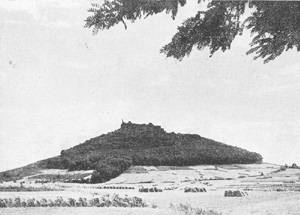
Fig. 1: Szigliget Castle Hill
The southern side of the hill is steep, while towards the north it rises gently. Its rock consists of tuff and coarse conglomerate5 cemented together from volcanic ash, marl, and sandstone fragments. A basalt dyke cuts through it in a west–east direction, separating into columns perpendicular to the cooling surface. The rock of this dyke is exposed by a small quarry on the eastern side, from which Valér Hulyák described phillipsite6 in 1903.
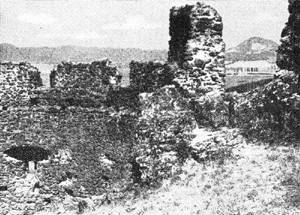
Fig. 2: Szigliget ruins
The castle standing on the hilltop was built by Favus, Abbot of Pannonhalma, after the Mongol invasion (Fig. 2). Until 1334 it was a royal castle. In the 15th century it belonged to the Újlaki family, and in 1490 it passed into the hands of the Lengyel family. During the Turkish wars it served as an important fortification. Like Csobánc, it was never taken by the Turks. In 1672 it was struck by lightning, caught fire, and was never rebuilt.
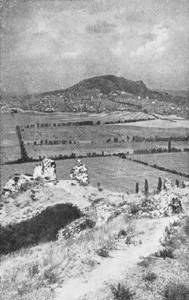
Szent György Hill seen from the Szigliget ruins
… The volcanoes of the Balaton region have long been extinct and have not been active since man has dwelt upon the earth, yet they remain witnesses to this day of the geological events that once unfolded here.
… The Hungarian soil and the Hungarian hills give bread. But alongside bread they also give fine wine — the celebrated wines of Szent György Hill, Badacsony, and Somlyó — the flower-filled, birdsong-filled forests of the hills offer rest, the waves lapping at the foot of the mountains offer recreation, and from early spring to late winter they offer every Hungarian a proud and abiding joy…
_______________________________________
EXPLANATORY NOTES
* The orthography and language of this work, published in 1954, may in places differ from current usage. The photographs were reproduced from zinc plates at low resolution.
1 The prehistoric history of our planet is divided by geology into four major groups on the basis of palaeontological (stratigraphical) criteria:
1. Archaeozoic (Primordial Era)
2. Palaeozoic (Ancient Era)
3. Mesozoic (Middle Era)
4. Cenozoic (Modern Era).
Within these groups, periods are distinguished, within periods epochs, and within epochs ages (stages). The Pannonian or Pontian age is the lower stage of the Pliocene epoch of the Cenozoic Era, while the Levantine age is the upper stage of the Pliocene. The Pannonian age dates to 10 million years ago, while the Levantine age to 2–3 million years ago.
2 The Triassic period is the lowest division of the Mesozoic Era, above which lie the Jurassic and, above that, the Cretaceous period.
3 The Tertiary (popularly "the third age") is the lower division of the Cenozoic Era, customarily subdivided into the following epochs: the most recent is the Pliocene (see above), followed by the Miocene, Oligocene, and Eocene.
4 The term Mediterranean refers to the middle stages of the Miocene.
5 Conglomerate: a clastic rock composed of larger, heavily worn, rounded pebbles and boulders cemented together. It is distinguished from breccia by the strong abrasion and rounding of its fragments, and from sandstone by the size of those fragments. The size of the fragments is highly variable: in one specimen they may be barely the size of a hazelnut, in another they may reach a diameter of one metre.
6 Phillipsite: also known as cubic zeolite on account of its form. A hydrous silicate containing calcium, sodium, and potassium alike. It occurs exclusively in twinned crystals. It is deposited in the vesicles of basalt and in the fissures of other deep-seated eruptive rocks.
(Source: http://www.zsebi2.hu/bfelvidek/bazalt/bazalt.htm#n)
(Dr. János Erdélyi: (1905 – 1977) mineralogist, university lecturer, Candidate of Sciences. He obtained his degree at the University of Budapest, where he also received his doctorate. He studied the formation of zeolites in the basalts of the Balaton Highlands.)