 CASTLES, MANORS, CHURCHES – Historical and Heritage Tourism Journal, October 2010, pp. 44–46.
At the invitation of Balázs Balassa, the mayor of Szigliget, experts involved in the maintenance and operation of castles gathered in Szigliget in September: castle captains from around Lake Balaton, specialists in tourism and environmental protection, and local patriots from Transdanubia and Northern Hungary. The introductory lecture, titled “Thoughts on Castle Tourism,” was delivered by the author of this article.
 I have already expressed my views on the utilisation of castles and castle tourism in issue 2/2009 of this journal. I assessed the quality of tourism services at Hungarian castles (in the form of a test) 35 years ago in the pages of the magazine Nagyító.
The situation regarding castle tourism and castle maintenance is extremely contradictory. Alongside good ideas and fine achievements, the overall picture is one of lack of coordination and the absence of a comprehensive concept.
It is generally true that the most spectacular and most visited relics of our past are our castles. Another fundamental fact is that most of our castles are ruins—indeed, largely decaying ruins. We do not have a single castle whose excavation and restoration have been completed, and where an exhibition presenting the castle’s history in a worthy and visually engaging manner would await visitors. Nor can we be satisfied with the quality of tourism publications. There are exceptions, of course, but still too few.
Events connected to our castles usually show little imagination and are sometimes even kitschy. In many places, they manage to put together some kind of programme for one or two weekends a year, but for most of the year only bare walls await visitors—or rather dull, content‑poor exhibitions, sometimes even a chilling wax museum (torture chamber). Compared not only to Western Europe but even to the castle tourism of neighbouring countries, what can be seen in Hungary is often considered underdeveloped. Yet it is by no means hopeless that we could compete with the West in certain areas.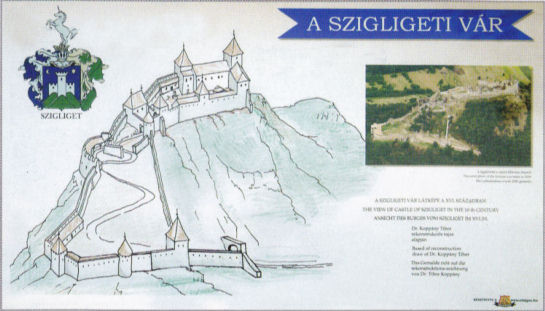
Some municipalities and civil organisations do their best, within their means, to protect and make their castles attractive. Szigliget is one such example: after the conservation and excavation works of the 1950s–60s, no continuation followed for decades, until the enthusiastic organisational work of architect József Paál led to the establishment of the Szigliget Castle Foundation. From 1992 onwards, the excavation of the lower castle began, and the work progressed steadily upwards to the oldest structures on the hilltop, and by 2010 it was largely completed. The results were summarised a decade ago by László Gere in a small booklet (Szigligeti vár), while the latest, more extensive and impressive publication is the work of historian László Hangodi (Historia castri Szigligetiensis. The History of Szigliget Castle, 2009). In it, Tibor Koppány’s drawing was made based on the known remains before the major excavations, while Frigyes Kőnig’s illustration already incorporates the results of the new research. The old core of Szigliget consists of traditional thatched houses—some old, some newer—built on the southern slope of the castle hill. In the centre stands the Aranypatkó Restaurant, furnished in a representative style. Opposite it is an espresso bar, and near the parish church at the beginning of the road leading up to the castle stands the L‑shaped, thatched‑roof building of the Castle Café. Turning left at the church, next to a spacious car park, visitors will find the Castle Inn established in the Lengyel Mansion. This was also the venue of the conference. The privately owned listed building has a sagging roof and is somewhat neglected. In contrast, the former Esterházy Mansion (and its 10‑hectare arboretum‑like park), now the Writers’ Union creative house, is well maintained. The village offers a wide range of restaurants and wine cellars (Esterházy Cellar, the Szászi family’s cellar, the Baráth family’s wine bar, St. Anthony Winery, etc.), and numerous rental apartments are also available.
The comments made by the participants responding to the introductory lecture painted a rather contradictory picture of the state of the castles. Konrád Végh from Csókakő proudly presented the monograph promoting their castle, yet did not hide how many struggles accompany its restoration. Attila Bozzay, operator of the tourist hostel at Várgesztes Castle, complained bitterly that the municipality expects taxes from them but offers little help. Yet substantial renovation would be necessary, and due to declining visitor numbers, even basic operation is becoming increasingly difficult. From Ferenc Erdősi we learned how devotedly the citizens of Bánd worked on the archaeological excavation and restoration of Essegvár. Captain Ferenc Nagy lamented the slowdown in the restoration of Csesznek Castle.
In general, participants criticised the bureaucracy and obstructionism of the heritage planning councils, as well as the anomalies of the grant system. Applications prepared with great effort and significant cost often end up lost in bureaucratic back‑and‑forth, and even the funds already awarded frequently fail to arrive. Due to the constant reorganisations within the heritage sector, it is often unclear who is actually responsible. Property ownership issues also pose difficulties. In Veszprém County, the period when Margit Pergő—warmly applauded—was in charge is regarded as a golden age.
There are also disputes with the Balaton Uplands National Park, though fortunately its director, László Balogh, spoke firmly in favour of cooperation. Thus, when teacher József Szászi explained that certain forest sections near the castle walls on Szigliget’s hilltop would need to be cut back in order to protect the plant communities of the wide, intentionally bare strip that had existed there for centuries, he did not reject the idea. Several participants also pointed out that environmental protection around the castle walls is likewise an important task.
After lunch, the group visited Szigliget Castle under the guidance of József Paál. From the top of the hill it was easy to observe how large an area had once been covered by water during the Turkish era. At that time, Szigliget was surrounded by the lake—a true island. This was the base of the Hungarian galley fleet, while the Turkish fleet was stationed at Siófok. It was suggested that reconstructing the historic boatmen’s fleet would be a unique attraction, and that reenacted naval battles could offer spectacular experiences.
Restoration of the gate towers of the lower castle at Szigliget has not yet been completed. There is hope that the walls may “rise higher,” using local rubble stones rather than artificial stone or concrete, as seen in so many unfortunate examples. The café and restaurant established in the lower castle are extremely popular with visitors (though the hospitality businesses in the village are less enthusiastic about this). The toilet facilities created in part of the former stables are also civilised and useful. Further on, the castle model is unfortunately outdated and does not show the structures uncovered during recent excavations.
On the sloping ground in front of the rondella, a seating area has been created, and below it a relatively small stage. This is where open‑air performances are held on summer weekends. The municipality has taken over the operation of the castle, resulting in improved standards and no financial loss. The reconstructed kitchen’s furnishings are somewhat modest, but since the room cannot be locked, placing more valuable items (even replicas) would not be advisable—several have already been taken by overly enthusiastic collectors. On the ground floor of the palace wing, a chapel has been created (likely on its original site), where mass can also be held. Only sky‑reaching wall stumps remain of the great tower, and its restoration is not planned. However, the view is breathtaking—toward Badacsony, Csobánc, the other extinct volcanoes, and the lake. The two large aerial photographs depicting Szigliget and its surroundings, as well as the castle itself, are also very impressive. The explanatory texts for the individual structures are somewhat long, especially in the foreign‑language versions, from which it would be advisable to omit the Hungarian personal names, as foreign visitors struggle to read them and cannot place figures such as Martonfalvay, Magyar Bálint of Palonai, or the Tóti Lengyel family.
The Castle Café building houses the castle‑history exhibition in two rooms. Here too stands the same (outdated) model as in the castle above, along with a few archaeological finds and display panels. This is rather modest. The problem is that the excavation material is practically inaccessible, unrestored, and unregistered. This is the situation at almost every castle excavation in the country. This is why major castle monographs are not produced, why exhibitions showcasing significant finds are lacking, and why stove reconstructions are rare exceptions. There are, of course, positive examples: the exhibition at Ozora Castle has recently been enriched with an impressive reconstruction of a Renaissance kitchen. It was suggested that it would be worthwhile to organise a “mini‑mundus‑style” exhibition presenting the former frontier castles, either in Szigliget or elsewhere. It turned out that such a plan had already been developed for Szigetvár Castle, as Gábor Báthory explained on behalf of the National Heritage Management. The plan was shelved at the time...
At Csesznek, Ferenc Nagy would like to create a truly spectacular castle exhibition. In the evening twilight, there was even time to discuss this on site. The lesson of the meeting was that it is worthwhile to gather and exchange experiences. There is now great anticipation as to whether the new budget will take castles into account within tourism. There is no other option but to formulate ideas and bombard the authorities with them. If we allow the castles to decay, we are “robbing” the generations that come after us.