DR. GYÖRGY ANTAL DIÓSZEGI
The Greek Prince of Medieval Szigliget
This year marks the 25th summer that my family and I have been visiting the wonderful castle of Szigliget. During one of these memorable occasions—on 1 August 2009—I won first place in the spear‑throwing competition held at the castle, while my wife’s cousin, András Bilkai from Csenger, achieved third place after three tie‑breaking rounds (out of ten participants). As a reward, Balázs Balassa, mayor of Szigliget, president of the Palonai Magyar Bálint Traditionalist Association, and captain of the Szigliget Castle, presented me with a beautifully produced book titled “Szerelmünk Szigliget” (Our Love, Szigliget), published in 2005. My friend Bandi was gifted a bottle of wine. These experiences—and my research into the millennia‑old history of Hungarian‑Greek friendship—led me to the little‑known story of “The Greek Prince of Szigliget.”
In the context of medieval Hungarian‑Greek relations, it is important to note that several Hungarian leaders were baptised according to the Greek rite in the 10th century. In 2000, our King Saint Stephen and Saint Hierotheos, the Greek missionary bishop of Hungary, were canonised by the Greek Patriarch of Constantinople into the saints of the Greek Church. King Saint Ladislaus’s daughter, Piroska, became Empress of Byzantium in Constantinople: she is venerated in the Greek Church as Saint Irene (later Xene). Margaret, daughter of King Béla III of Hungary (1172–1196), became a Byzantine empress under the name Maria. The distinguished historian Mór Wertner wrote that Kaloján, a Greek and Hungarian prince, was one of the landowners of Szigliget in the 13th century. (1)
But how could a Greek prince have come to Szigliget? The explanation lies in his ancestry: Kaloján descended on his father’s side from the imperial Greek family of Constantinople, and on his mother’s side from the Árpád dynasty. Through his mother, Princess Margaret, he was the grandson of King Béla III of Hungary. Margaret (Esztergom, 1175–1223) married Isaac II Angelos, Byzantine emperor (sole ruler 1185–1195, co‑ruler 1203–1204). Their son was the Greek prince Ioannes Angelos—known in Hungarian history as Kaloján. He must have been a handsome man, as his Hungarian name derives from the Greek Kaloioannész, meaning “Fair John.” His name appears in the forms Kaloioannisz, Kalojoannes, and in a slightly Hungarianised version as “Kalo‑János.”
The Hungarian Catholic Lexicon, citing another study by Mór Wertner (“The Sons of Empress Margaret,” Századok, 1903, p. 593), records that Ioannes Angelos (c. 1203–c. 1259) was a Greek and Hungarian prince. In 1222 he arrived from Thessaloniki with his mother—by then widowed several times—to the court of his uncle, King Andrew II of Hungary (1205–1235). László Gere wrote that Szigliget became Kaloján’s estate from 1233 onward, and also noted that the prince was a cousin of King Béla IV. From 1252 until his death in 1259, he served as ispán (county head) of Zalavár. (2)
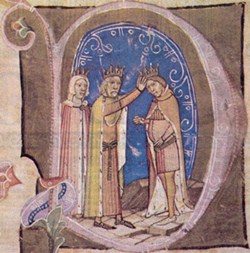
Wertner also wrote in 1898 that after the death of Kaloján, Greek and Hungarian prince, Szigliget was granted to Stephen, son of King Béla IV—known as “the second founder of the homeland”—and Queen Maria Laskarina. This is an important and fascinating detail. In one of the illustrations of the 14th‑century Chronicon Pictum, Maria Laskarina—the Nicaean Greek imperial princess who became Queen of Hungary—is depicted at the moment when her husband, King Béla IV (1235–1270), appointed their son Stephen as junior king. Thus, this young Stephen—later King Stephen V—was also lord of Szigliget. It is worth noting that through his mother, he too was of Greek descent.
These Hungarian‑Greek historical connections remind us of the deep roots and enduring strength of the millennia‑old friendship between our two nations. Its essential and universal message for our present and future is that nations who respect one another are themselves worthy of respect.
Sources: (1) Mór Wertner: “County Officials of the Árpád Era. III. Final Study.” In: Magyar Történelmi Tár, 3rd series, vol. 21, 1898. (2) László Gere: Szigliget from Prehistory to the Present. Szigliget, 2003, p. 5.
Dr. György Antal Diószegi, legal counsel, family historian, researcher of Greek history.
Born in Budapest in 1962. His mother, Anna Katalin Spilenberg of Hadusfalva, is an economist and co‑owner of a company. His father, György József Diószegi (1936–2005), college professor and writer, taught for 45 years at the Bánki Donát College of Mechanical Engineering (and its predecessors) as an engineering instructor.
Among his maternal ancestors are members of the 17th–19th‑century Greek families of Tokaj: the Papademos Charis / Szerviczky‑Karátsonyi and Demeczky lineages.
Research fields: local history, family history.
His scholarly work is marked by numerous studies and articles: he has been publishing since 1981 (in Magyar Nemzet, Tokaj és Hegyalja, Ethnica, Agora, Ellinizmos, Partium, Istros, Széphalom, Honismeret, Trianoni Szemle, Debreceni Szemle). Of his 110 published historical studies and articles, roughly half analyse the value‑creating presence of the old 17th–19th‑century Greek communities in Hungary—particularly during the Rákóczi era, the Reform Age, the 1848–1849 War of Independence, and the post‑Trianon economic rebuilding.