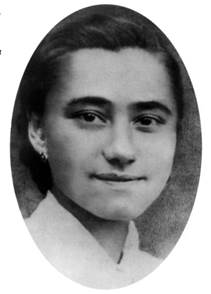
Magdolna Bódi was born on August 8, 1921, in Szigliget. She was baptized in the church of Badacsonytördemic on August 15. Magdi’s parents were estate servants. Due to the lack of her father’s documents, her parents could not enter into either a church or a civil marriage. Magdi did not receive religious upbringing in the family; she could only attend religion classes at school. Her catechist and teacher soon noticed her. From her First Holy Communion onward, Jesus Himself attracted and guided her soul, which was receptive to all that is good. She was a resourceful, cheerful child and a good student.
 Bódi Magdi and her siblings
She loved reading very much. Through various religious books she acquired increasingly profound knowledge of the faith, which she strove to put into practice.
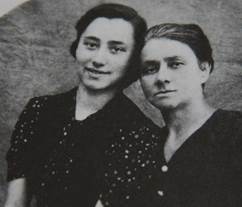 Magdi with her mother
By the age of eleven, Magdi was already helping diligently with household tasks and became her mother’s right hand in field work as well, who soon noticed her long, persevering prayers. These increasingly strengthened her fidelity to Jesus and trained her will. She helped wherever she saw need.
At seventeen, a parish mission was held in Balatonfűzfő. She was drawn to religious life, but her canonically irregular birth was an obstacle to this. With a sorrowful heart she accepted that, according to the rules of religious orders at the time, she could not follow this desire.
The following year she became a factory worker at Nitrokémia Rt. in Fűzfőgyártelep. Despite working in three shifts, she found a way to receive Holy Communion daily.
Many different people worked at the factory; swearing was common, as were anti‑church and slanderous remarks. Her co‑workers noticed that Magdi responded resourcefully to the teasing directed at her because of her religiosity. She refuted anti‑church accusations with firm worldview knowledge and intelligent reasoning, but never in a hurtful manner. Since her behavior was characterized by gentle modesty, the initial resistance of her colleagues turned into respect. In her presence, they already watched their words. The factory management also appreciated her good work.
She became an attractive young woman and had several suitors, yet she did not choose motherhood. At the age of twenty, during her first closed retreat, after due consideration, she made a vow of chastity in 1941. In 1942 she was admitted to the Marian Congregation. After this, she devoted herself with even greater zeal to the children she had already been leading within the Sacred Heart Guard.
Alongside all this, she tried to help everyone in need through many forms of charitable service. This work intensified after she completed the leadership training course of the Catholic Working Girls’ Association and organized a small group of older girls. In the spirit of the association, she formed a community of young women working in industry, educating them to a conscious Catholic worldview, while they jointly carried out charitable and apostolic work, characterized by youthful joy.
Magdi asked the Lord to let her die young and that even through her death she might help bring young people closer to Him.

By 1944, her family was living in Litér. In December, the sounds of battle could be heard ever closer. Hearing distressing news about the fate of women, she resolved to keep the vow she had made to Jesus even at the cost of her life. The time for this came on March 23, 1945.
The women were standing at the entrance of the shelter when two armed Soviet soldiers arrived. One of them became Magdi’s attacker. Magdi resisted and, freeing herself from the soldier, tried to escape, while at the bunker entrance she warned the others with an agitated face but calm voice: “Annuska, run, it will be your turn. I am already going to die… Mother, go away from here, I am going to die now!” Meanwhile, the soldier appeared at the other exit. Seeing Magdi in the yard, he immediately fired. About six bullets struck Magdi in the back. At the first shot she stopped, at the second she raised both arms toward heaven, and with the words: “My Lord, my King! Take me to Yourself!” she pressed the rosary once more in her pocket. The last bullet pierced her heart.
Two weeks later—based on the special permissions granted by Rome for the time of siege—her parents were able to enter into a sacramental marriage. According to the state laws of the time, this was also recognized as a civil marriage. From then on, her parents lived a religious life.
Magdi lived in circumstances unfavorable to a committed life of faith. Even religious orders did not accept her among their members, yet she remained faithful to Christ until her death. Her witness among factory workers, her multifaceted work in charitable service, and her organizing and spiritual leadership of young working women into a community remain exemplary today.
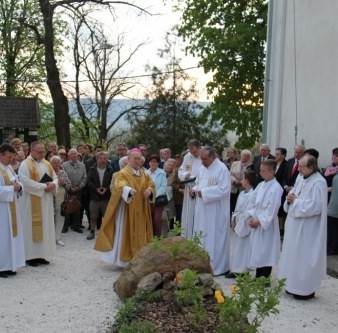
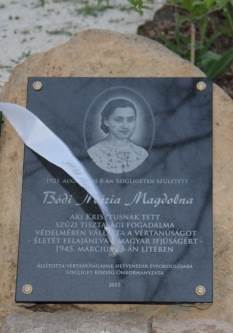
In April 2015, on the 70th anniversary of Magdi’s martyrdom, a memorial plaque was erected for her in the garden of the church in Szigliget. The festive Mass and the blessing of the plaque were celebrated by Archbishop Gyula Márfi of Veszprém. It is a beautiful custom that every year a pilgrimage is organized that visits the important places of the saintly young woman’s life.
The beatification process of Magdolna Bódi has already begun; we hope she will find her place among the blessed and saints of Hungary.